Clipping diodes are the heart and soul of overdrive and distortion pedals. They are responsible for the satisfying crunch, sustain, and harmonic richness that defines countless iconic guitar tones. However, not all clipping is created equal. The type of diode, its placement in the circuit, and its symmetry all dramatically impact the final sound coming out of your amplifier.
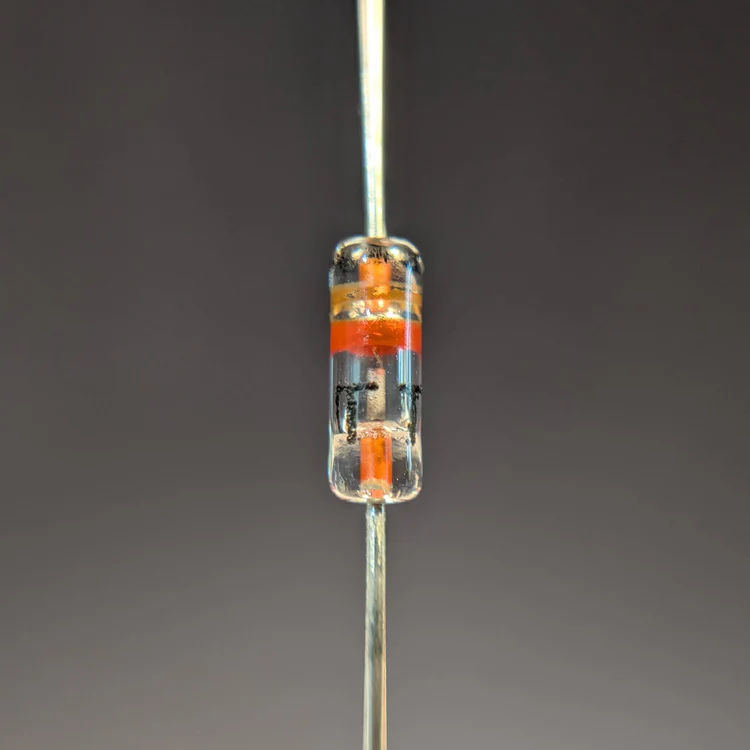
Historical Context: The Shift from Germanium to Silicon
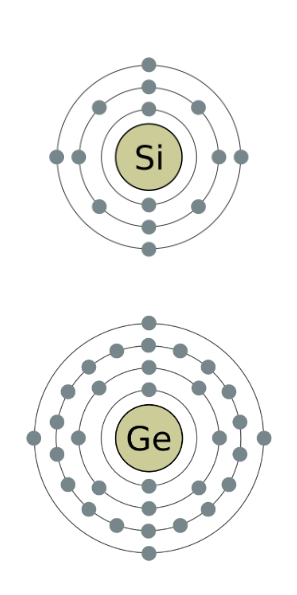
The first semiconductors used in electronic circuits were germanium based. Throughout the 1950s, germanium was the standard material for manufacturing both diodes and transistors. However, germanium is inherently unstable: it is highly sensitive to ambient temperature and difficult to produce with consistent electrical tolerances.
By the mid-1960s, the broader electronics industry shifted almost entirely to silicon. Silicon diodes are more robust, cheaper to manufacture, and offer high thermal stability. While most engineering fields abandoned germanium, guitar pedal designers eventually realized that its technical limitations were actually sonic advantages. Specifically, the lower voltage threshold and the gradual, non-linear transition into conduction (the "soft knee") of germanium produce a distinct harmonic profile that silicon's abrupt switching cannot easily replicate.
Forward Voltage (Vf) and the Clipping Threshold

To understand how a diode distorts a signal, you must understand Forward Voltage (Vf). A diode acts as a voltage-sensitive gate. It remains non-conductive until the signal voltage reaches its specific Vf threshold.
Once the guitar signal exceeds this threshold, the diode begins to conduct, shunting the excess voltage to ground (in hard clipping) or through a feedback loop (in soft clipping). This process "clips" the peaks of the waveform. The lower the Vf, the less headroom the circuit has before distortion begins.
Why Germanium Has a Lower Vf
The Vf is determined by the "bandgap" of the semiconductor material. Germanium has a much narrower bandgap (roughly 0.67 eV) compared to silicon (1.1 eV). Because it takes less energy to move electrons across a germanium junction, the "toll" or voltage required for conduction is significantly lower—typically 0.2V to 0.3V versus silicon's 0.6V to 0.7V.
Hard Clipping vs. Soft Clipping
Now let's see what happens when you pass audio across diodes. The most fundamental difference in pedal design is how the diodes are integrated into the circuit. This determines if your pedal feels like a smooth "overdrive" or an aggressive "distortion."
Hard Clipping: Diodes to Ground
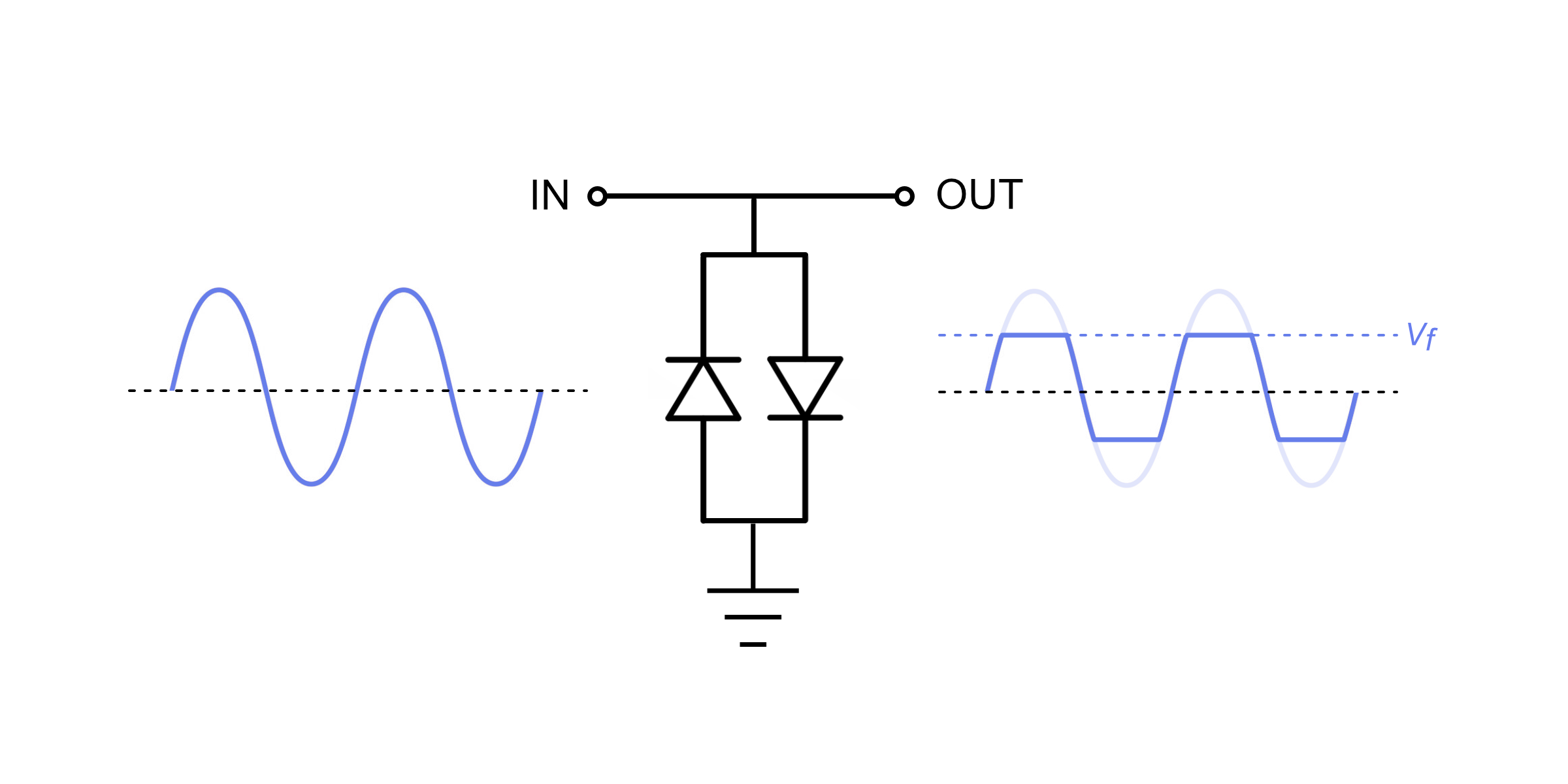
In hard clipping configurations, diodes are placed after the gain stage and connected from the signal path to ground. When the signal exceeds the diode's Vf threshold, the diodes conduct and literally chop off the peaks of the waveform. This creates an aggressive, buzzy distortion with prominent odd-order harmonics.
Famous Hard Clipping Pedals:
- ProCo RAT
- MXR Distortion+
- Boss DS-1
- DOD 250
Soft Clipping: Diodes in the Feedback Loop
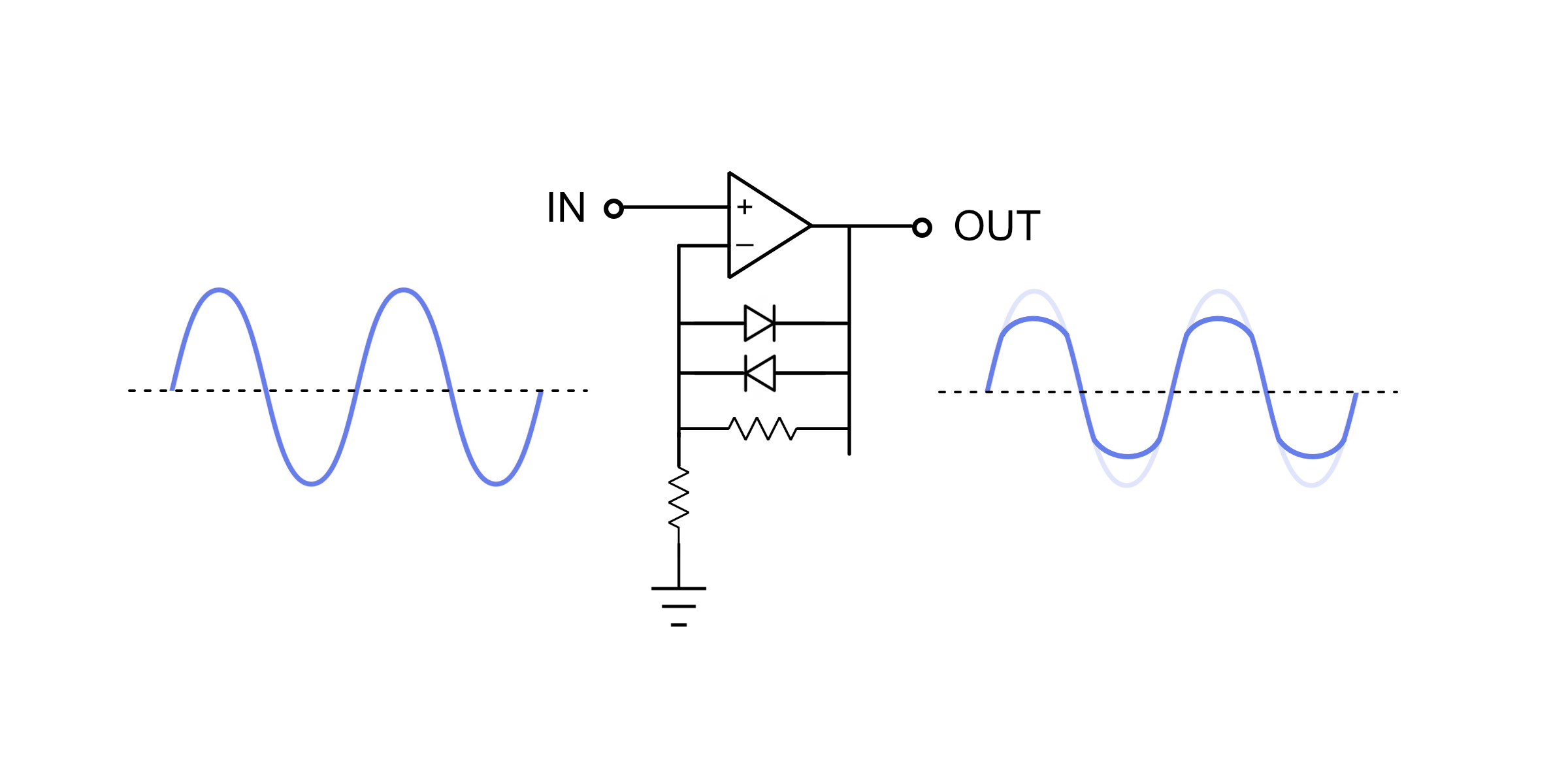
Soft clipping places diodes in the negative feedback loop of an op-amp. When the signal goes above the Vf threshold and the diodes engage, gain to the op-amp is reduced rather than abruptly chopping the signal. This creates a more gradual, rounded clipping that sounds more amp-like and touch-sensitive.
Famous Soft Clipping Pedals:
- Ibanez Tube Screamer (TS808/TS9)
- Boss SD-1 Super Overdrive
- Klon Centaur
- Marshall Bluesbreaker
- Paul Cochrane Timmy
- Nobels ODR-1
Symmetrical vs. Asymmetrical Clipping
Beyond placement of the diode, the "shape" of the clipping matters. This is where you can fine-tune the texture of the gain based on the symmetry of the diodes.
Symmetrical Clipping
When identical diodes are arranged in opposite polarity (typically two diodes facing each other), both the positive and negative halves of the waveform are clipped equally. This creates a more focused, tighter sound with predominantly odd-order harmonics. Most mainstream overdrive and distortion pedals use symmetrical clipping for a modern tone.
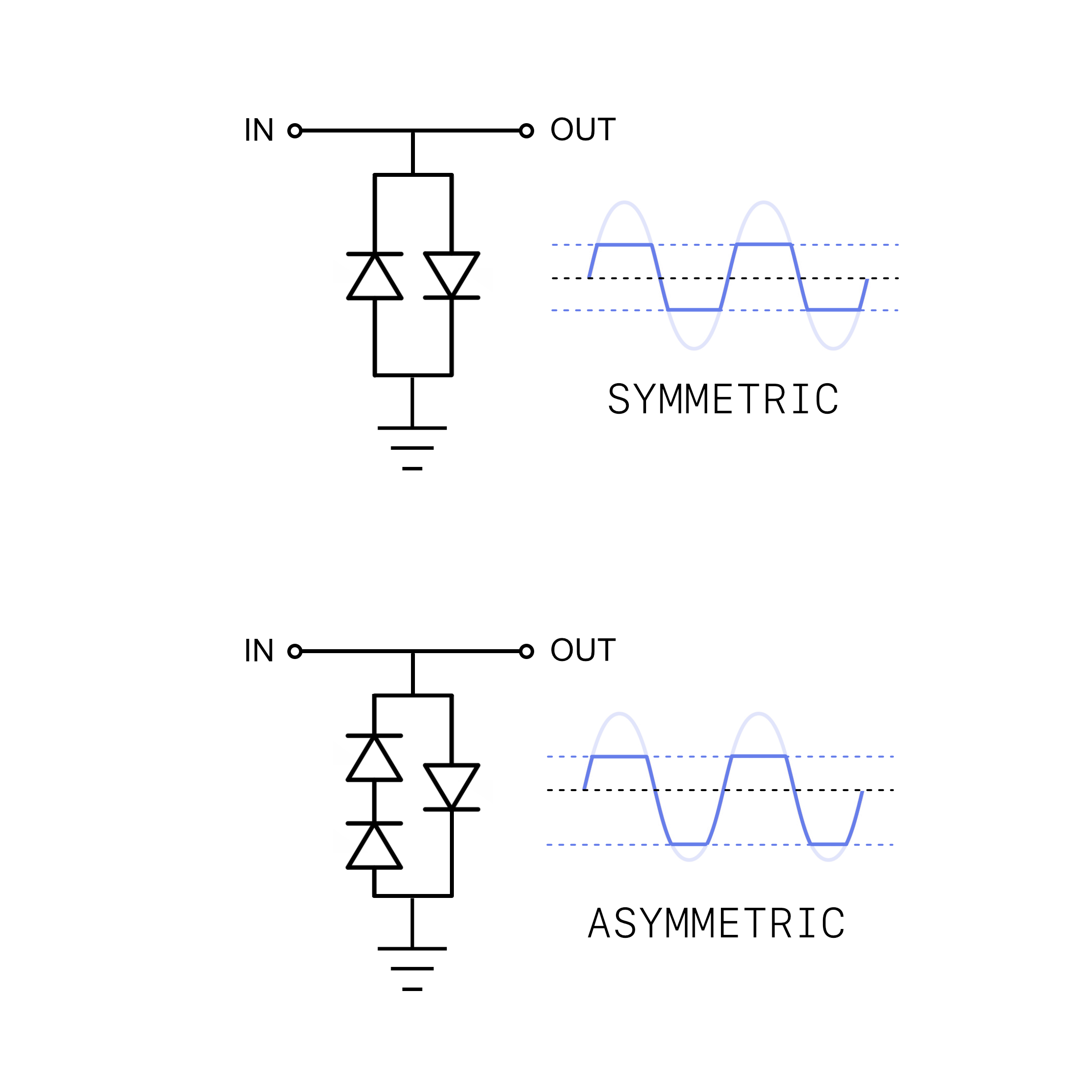
Asymmetrical Clipping
Asymmetrical clipping occurs when the positive and negative halves of the waveform are clipped differently. This is achieved by using different diode types, adding an extra diode on one side, or using diodes with different forward voltages. This causes the audio signal to be clipped at different levels in the positive and negative swings of voltage, resulting in an asymmetrically shaped wave. The result is a tone closer to tube amp distortion, rich in even-order harmonics that the ear perceives as warmer and more musical.
Series Stacking and Clipping Headroom
Forward voltage is additive when diodes are "stacked" in series. A single silicon diode clips at 0.7V, but two in series raise the threshold to 1.4V—providing more headroom and a more open, dynamic response. This technique is famously used in the Analogman King of Tone and the Marshall Bluesbreaker, which place two silicon diodes on each side of the clipping stage for a transparent, amp-like character.
Understanding the "Knee" of the Curve
The transition from a non-conductive state to a conductive state is not always instantaneous. This transition is referred to as the Knee.
Hard Knee
The diode conducts almost immediately upon reaching Vf. This results in a sharp, squared-off waveform, which the ear perceives as aggressive and high-gain. Silicon diodes typically exhibit a harder knee.
Soft Knee
The diode has a more gradual "turn-on" phase. As the signal approaches Vf, the diode begins to leak current slightly before fully conducting. This rounds the edges of the clipped waveform, mimicking the natural compression of a vacuum tube.
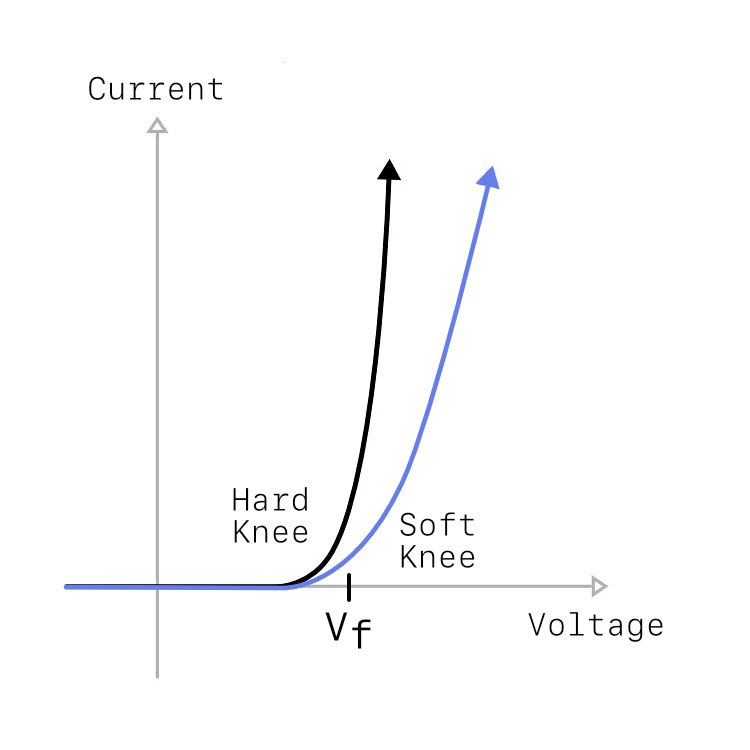
In addition to having a lower Vf than silicon, germanium diodes have a much softer knee. This is why germanium pedals often have a touch-sensitive feel that transitions gradually from clean to distorted as you play harder.
The Science of Leakage
In the world of precision engineering, "leakage" is usually a defect. It refers to the small amount of current that flows through a diode even when it is supposed to be "off." Silicon diodes have negligible leakage, which is why they stay clean right up until they clip.
However, germanium is naturally "leaky." This means that as your guitar signal grows, the germanium diode begins to conduct current slightly before it reaches its Vf threshold. This parasitic leakage is exactly what creates the "Soft Knee." It rounds the edges of the waveform, providing a smoother transition into distortion and a more compressed, tube-like feel. This is why a germanium diode with a 0.3V threshold often sounds "warmer" than a silicon diode with the same Vf.
Comparing Diode Technologies
While germanium and silicon are the most common, modern pedal design utilizes several other types of components to achieve specific results.
LEDs (Light Emitting Diodes)
Constructed using materials like gallium arsenide. They have a very high Vf (typically 1.8V to 3V), meaning they offer massive headroom and a very "crunchy" but open sound.
Schottky Diodes
Use a metal-semiconductor junction rather than the standard P-N junction. This construction results in a very low Vf and an incredibly fast switching speed. Sonically, they act as a bridge between germanium and silicon.
MOSFETs
Builders often use the "body diode" of a MOSFET by tying the Gate to the Drain. These have a Vf similar to silicon (around 0.6V to 0.7V) but feature a unique, compressed "sag" that feels very much like a pushed tube amp.
Transistors as Diodes
In some circuits, designers use a standard Bipolar Junction Transistor (like a 2N3904) and only connect the Base and Emitter. This essentially turns the transistor into a high-quality silicon diode with a very specific, sharp clipping character.
| Diode Type | Forward Voltage (Vf) | Sonic Character |
|---|---|---|
| Germanium | ~0.25V to 0.35V | Warm, vintage, compressed, and very touch-sensitive. |
| Schottky | ~0.15V to 0.45V | Reliable but vintage-voiced; very low clipping threshold. |
| Silicon | ~0.6V to 0.7V | Tighter, more aggressive, and more headroom than germanium. |
| MOSFET | ~0.6V to 0.8V | Smooth, amp-like sag with silicon-level volume. |
| LED | ~1.5V to 2.2V | Open, dynamic, and crunchy with very high headroom. |
A Note on Construction
The physical construction of these components dictates their sound. Standard silicon and germanium diodes are P-N junctions, where two types of semiconductor material meet. Schottky diodes use a metal-to-silicon junction, which is why they are so much faster and have lower resistance. LEDs use electroluminescent materials that require much more energy (voltage) to "light up" and conduct, which explains why they provide so much more volume and headroom before they start to clip your signal.
The Germanium Problem: Scarcity and Cost
Germanium diodes are technically obsolete. They have not been manufactured in significant quantities for decades because silicon is more consistent. The units available today are usually NOS (New Old Stock) sourced from surplus.
This creates several hurdles for builders:
- Cost: NOS 1N34A diodes can cost several dollars each compared to pennies for silicon.
- Inconsistency: Forward voltage varies significantly between units, requiring tedious hand-matching.
- Temperature Sensitivity: Germanium characteristics change with temperature, which can alter your tone mid-set.
- Fragility: Most NOS germanium diodes are housed in brittle glass envelopes that can crack if the leads are bent too close to the body.
Legendary Diodes and Brands
In the boutique world, specific NOS models have reached legendary status. The ITT and General Instruments (GI) 1N34A diodes are highly sought after, largely due to their role in the Klon Centaur. Early MXR Distortion+ units were also famous for their use of 1N270 germanium diodes, which gave them a warmer, fuzzier edge than later silicon versions.
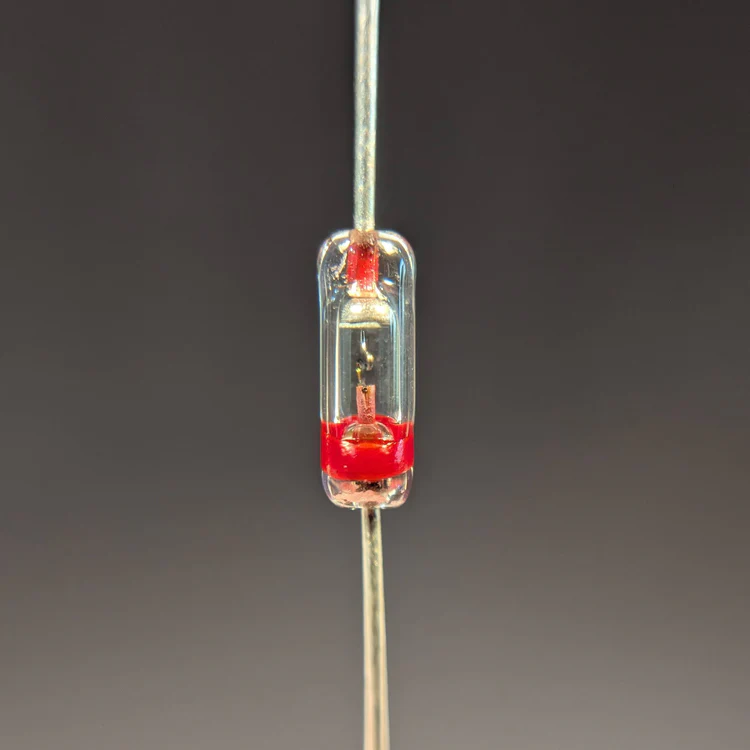
Other common American-made models like the 1N60 and 1N270 are staples of the vintage pedal sound. Due to the dwindling supply of Western-made glass diodes, many builders have turned to Soviet-era diodes (such as the D9B or D9E). These Russian components are often built to high military specifications and provide a reliable, high-quality germanium alternative for modern builders.
The Verdict
Understanding clipping diodes helps you decode why certain pedals feel the way they do. Whether you prefer the warm compression of germanium, the aggressive bite of silicon, or the open dynamics of LED clipping, there is a configuration for every playing style. The best way to learn is to trust your ears and experiment with different circuits to find your perfect tone.