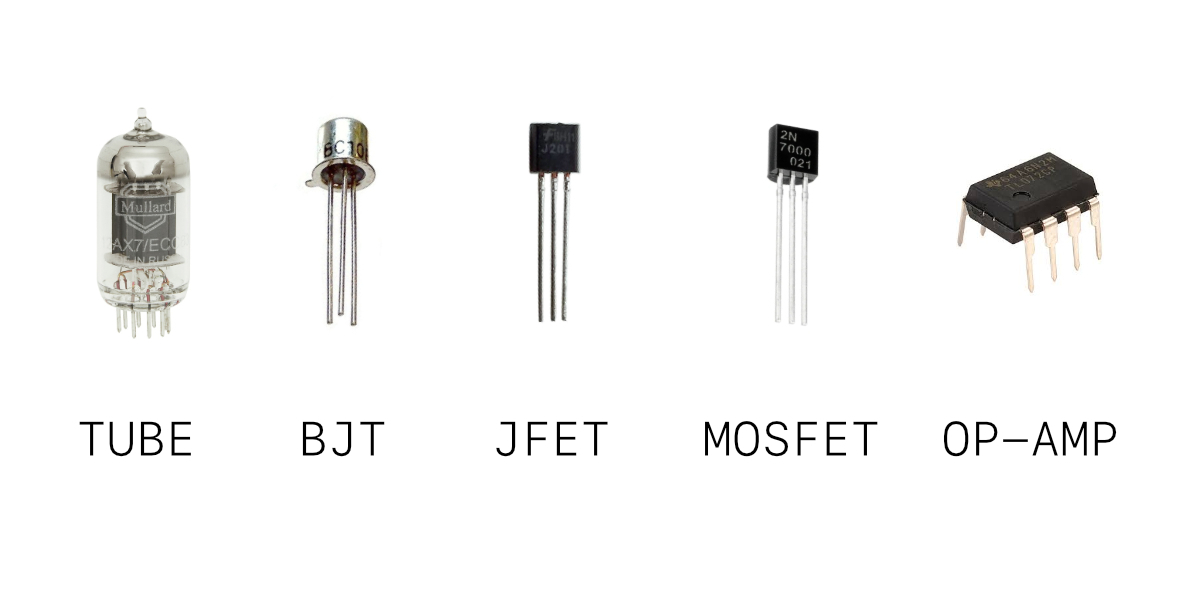
Amplifying a guitar signal is a deceptive challenge. You must take a fragile signal of only a few millivolts from a pickup and magnify it into something strong enough to drive a circuit or a speaker. You can't just apply voltage to the signal, as the power source would overwhelm the waveform. Instead, you must use that small oscillating input signal to control a much larger, separate power source.
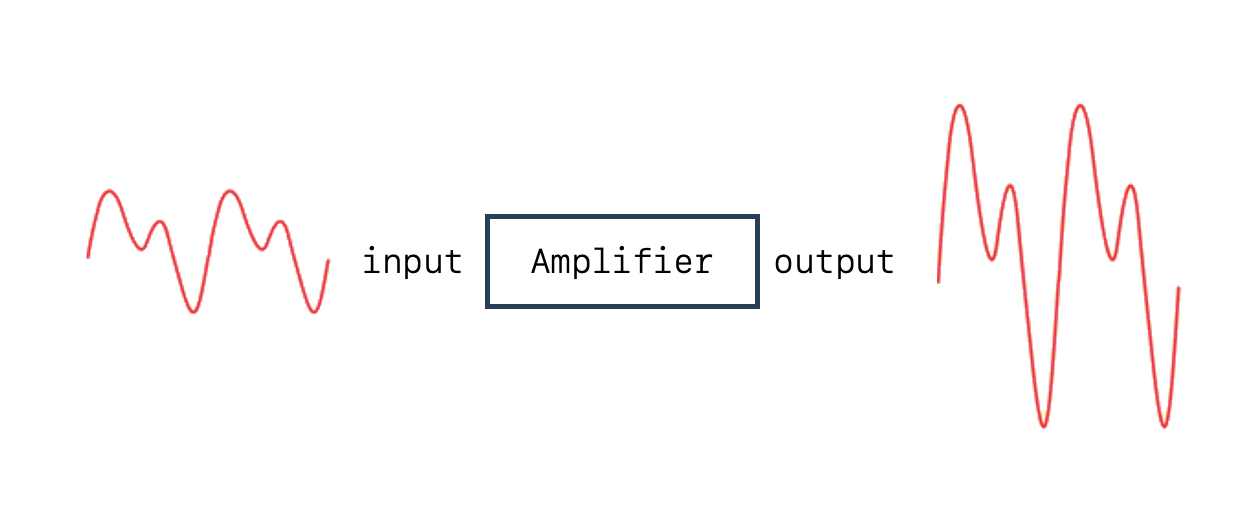
The way a component handles this handoff defines its entire electronic character. It isn't just about volume; it's about how the device resists the input through impedance, how it reacts to varying frequencies, and how it behaves when it runs out of headroom and hits saturation. Each of the Five Pillars uses a different physical method to manage this power, defining the tone.
The Hydraulic Analogy: Controlling the Flow
To visualize this, imagine a dam holding back a large reservoir of water. The water pressure behind the dam represents your power supply (V+). You want to control the release of that water using only the energy from a small, weak stream, which represents your guitar signal.
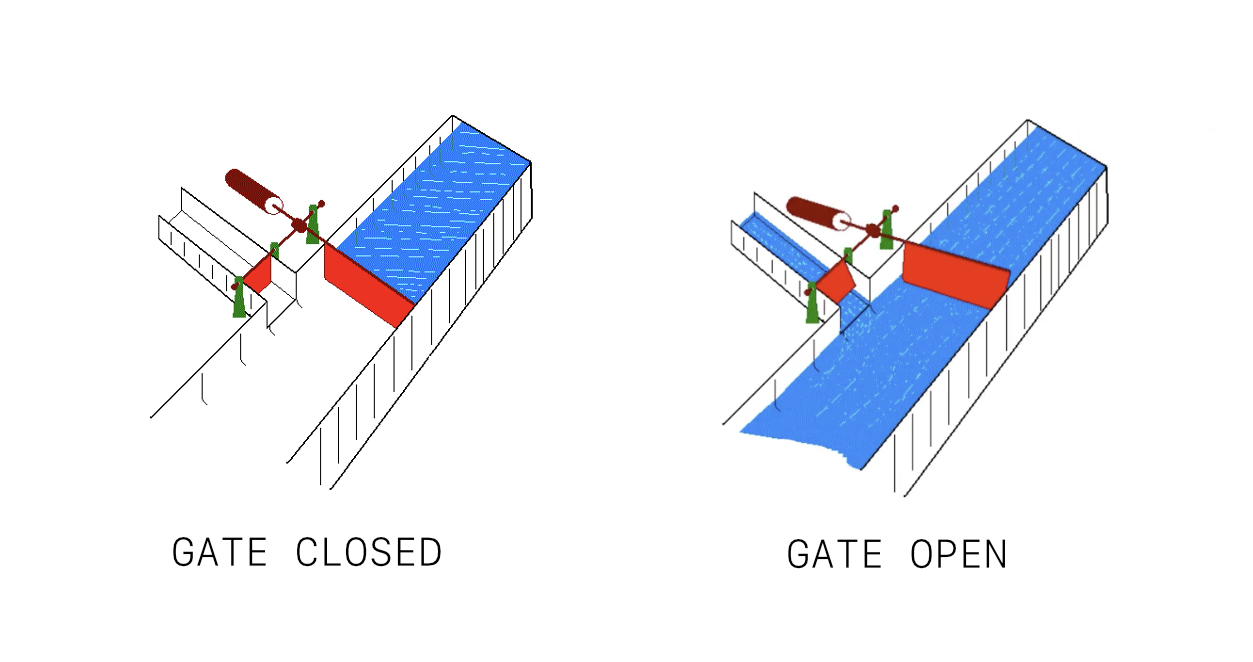
If that stream hits a paddle attached to a lever, that lever can open a much larger gate on the dam. The tiny energy of the stream now dictates the flow of the reservoir. In electronics, the "Five Pillars" are the specialized gates designed for this task. They must be sensitive enough to react to the stream's nuances without blocking the flow.
The Five Pillars of Gain
1. Vacuum Tubes (The Thermionic Valve)
The foundation of guitar tone began with an accidental discovery. In the late 19th century, Thomas Edison noticed that electrons would radiate from a heated filament and land on a nearby metal plate inside his lightbulbs. This "Edison Effect" provided the spark for the first true amplification gate.
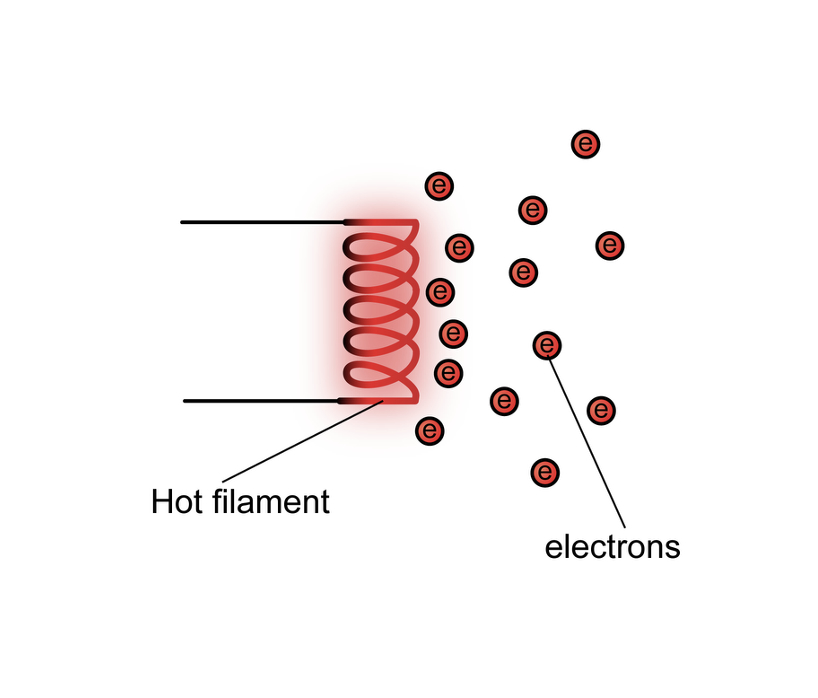
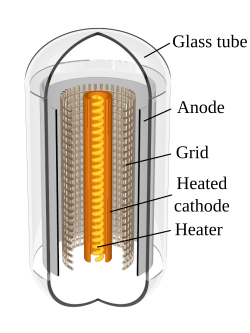
In 1906, Lee de Forest added a third element to this vacuum: a tiny wire mesh called the Grid. By placing this mesh between the heated filament and the plate, he could control the flow of electrons using a small voltage. Because the mesh was mostly empty space, the electrons could pass through it, but the voltage on the wire acted like a force field to gate the flow.
This technology powered the first guitar amplifiers and remains the gold standard for tone. When pushed into saturation, tubes compress gracefully, adding rich even-order harmonics that the ear perceives as warm and musical. This is the sound of rock and roll itself—from the crunchy power chords of AC/DC to the singing leads of Jimi Hendrix, the vacuum tube is responsible for virtually every iconic guitar tone of the 20th century.
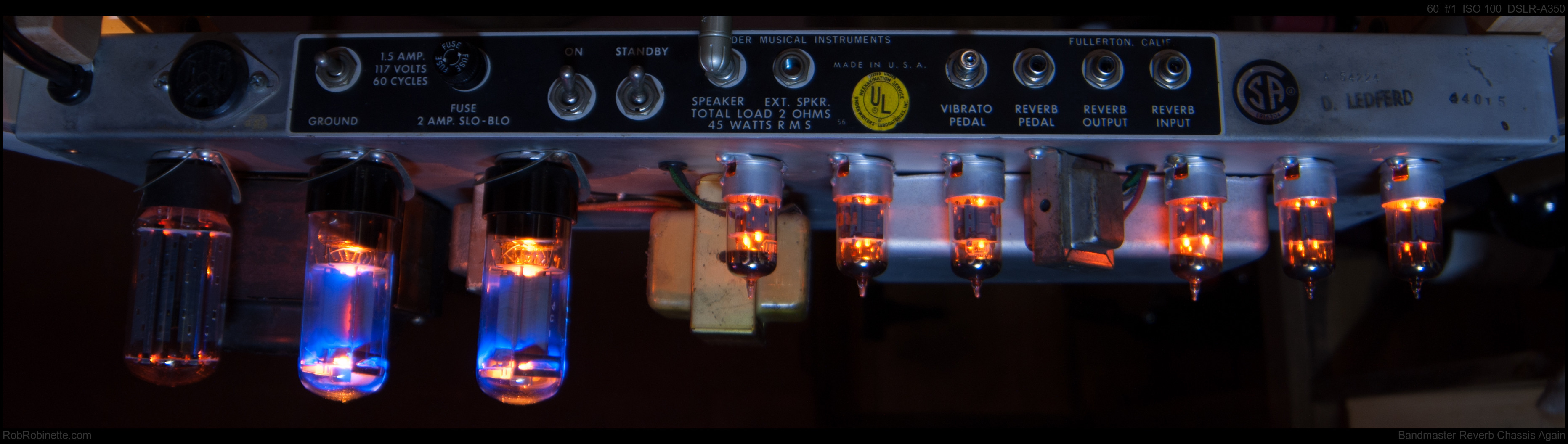
Vacuum Tube Characteristics
2. Bipolar Junction Transistors (BJT)
By 1947, the control gate moved from a vacuum into solid materials. Researchers at Bell Labs discovered they could take a semi-conductive material called Germanium and "dope" it with impurities. By creating layers of "N-type" and "P-type" material, they created a solid-state gate that functioned like a vacuum tube but was smaller, cooler, and far more durable. Silicon transistors arrived later in the 1950s, eventually becoming the dominant material due to their stability and heat tolerance.
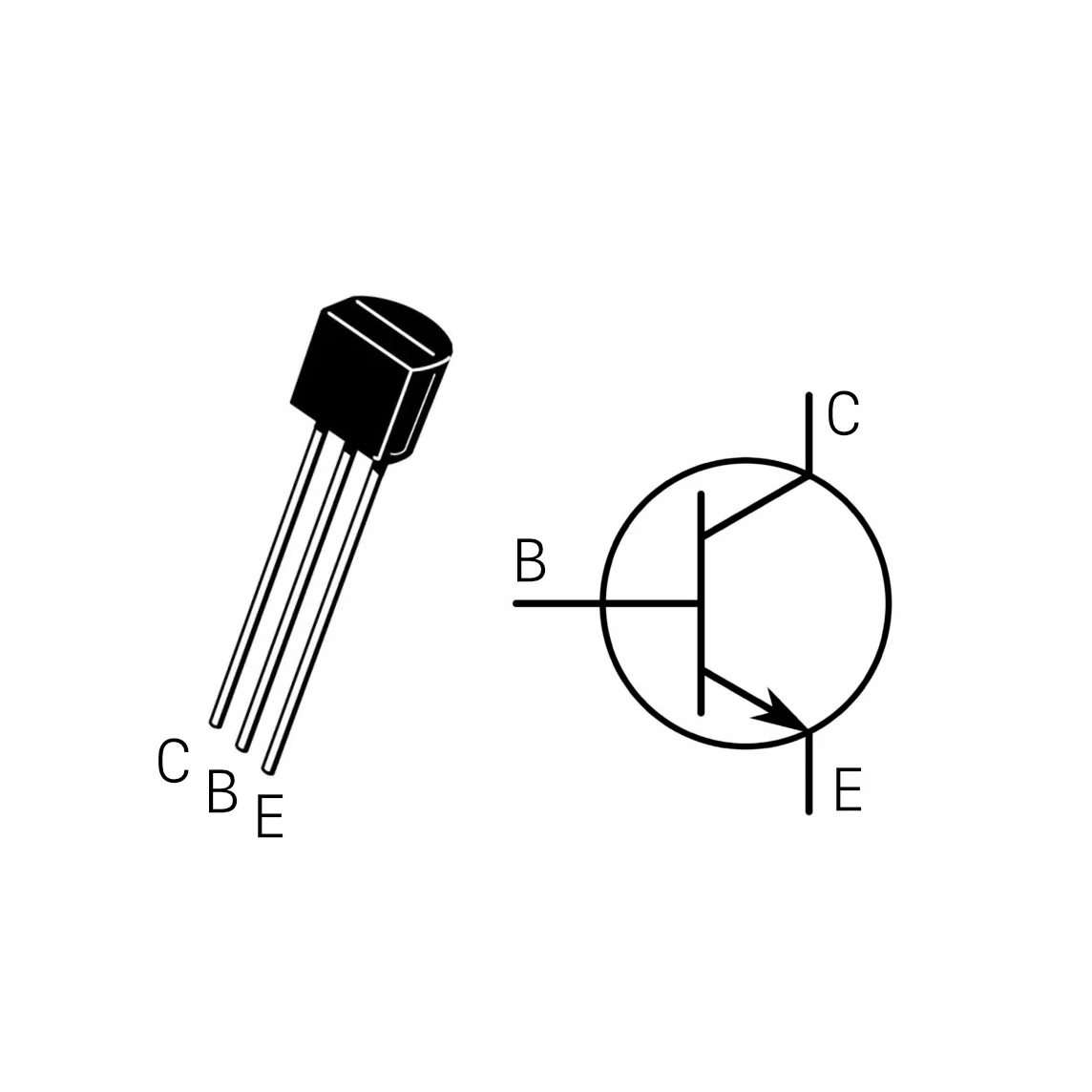
The BJT didn't just enable portable amplification. It invented fuzz. In 1966, the Arbiter Fuzz Face and the Dallas Rangemaster arrived, and rock guitar was never the same. The Fuzz Face, with its simple two-transistor circuit, gave Jimi Hendrix that singing, violin-like sustain. The Rangemaster, a single-transistor treble booster, pushed amps into saturated bliss and defined the sound of Eric Clapton's "Beano" tone and Tony Iommi's early Black Sabbath riffs. The Tone Bender, the Fuzz Tone, the Electro-Harmonix Big Muff: all BJT circuits. The entire category of "fuzz" exists because of this component.
Unlike the tube, however, this gate requires a physical flow of electricity to operate. The BJT's "current-controlled" nature gives it that distinctive interactive feel. Roll back your guitar volume and the fuzz cleans up beautifully, because you're starving the transistor of the current it needs to saturate.
BJT Characteristics
3. JFET (Junction Field Effect Transistor)
If the BJT was a radical departure from the vacuum tube, the JFET was a return to form. Developed in the 1950s but perfected for audio in the 60s and 70s, the JFET was designed to act as a "solid-state valve." Instead of requiring a physical flow of current to open the gate like a BJT, the JFET uses an electric field to "pinch" a conductive channel. This allows the device to "feel" the guitar signal without pulling energy from it.
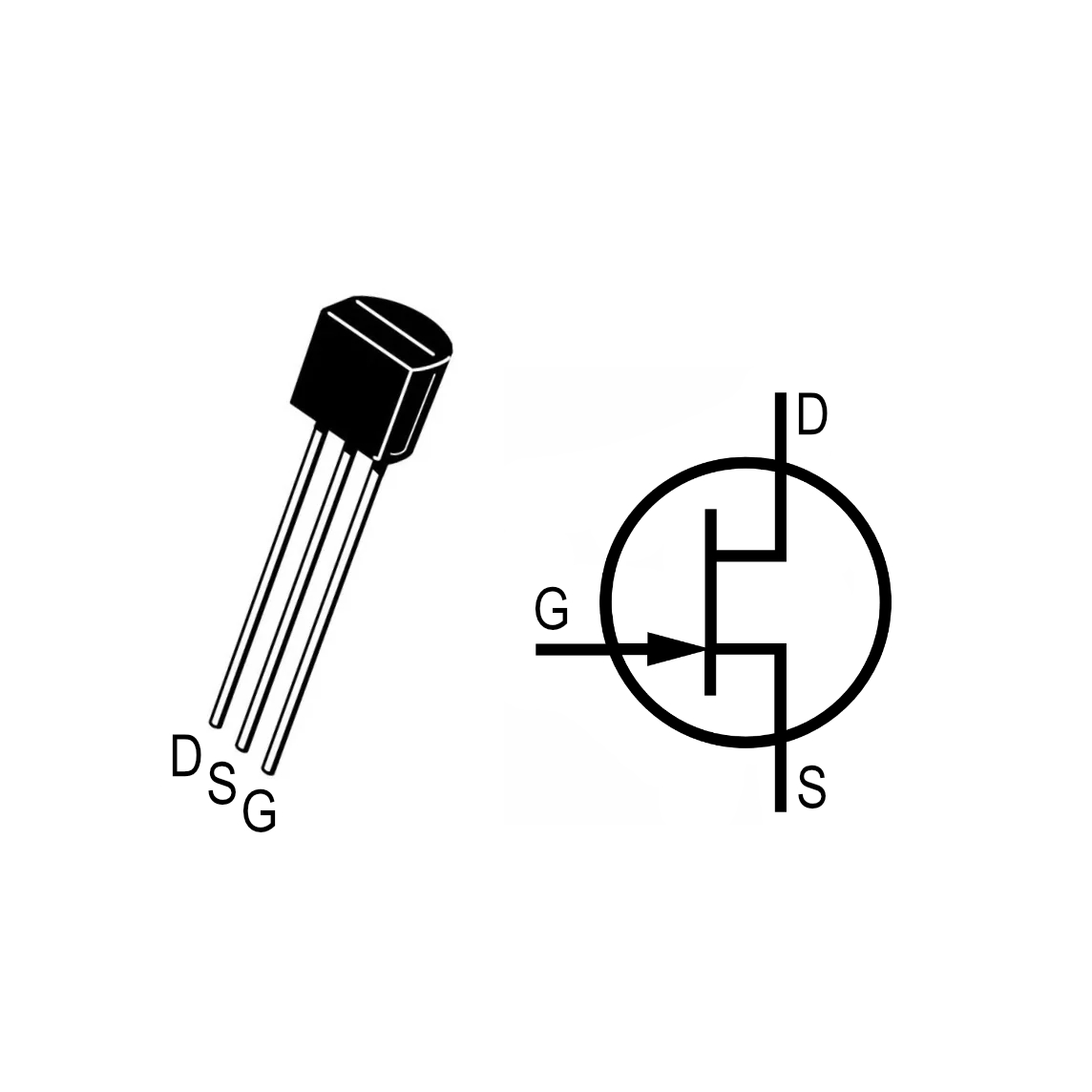
Because of this tube-like behavior, JFETs have become the go-to component for boutique pedal design. The humble J201, a tiny and inexpensive transistor, is the secret ingredient in many of the most sought-after "transparent" and "amp-like" overdrives. The Benson Preamp, celebrated for its rich harmonic content and tube-like feel, is built entirely around JFET gain stages. The JHS Morning Glory uses JFETs in its boost section. The "amp in a box" pedals that faithfully recreate Marshall, Fender, and Vox preamps are almost all JFET-based.
There's just one problem: through-hole JFETs have become extinct. The beloved J201, along with its sibling the 2N5457, were discontinued years ago. The through-hole versions have become collector's items, with some selling for ten times their original price. Surface-mount versions like the MMBFJ201 are still widely available, so most boutique builders have redesigned their PCBs to accept these tiny components.
JFET Characteristics
4. MOSFET (Metal-Oxide-Semiconductor FET)
The MOSFET takes the concept of the field-effect gate a step further by adding a layer of insulation (usually metal-oxide) between the gate and the channel. This creates a gate that acts almost like a tiny capacitor. Because the gate is completely insulated, it draws virtually zero current from your guitar, making it the most efficient "observer" of your signal.
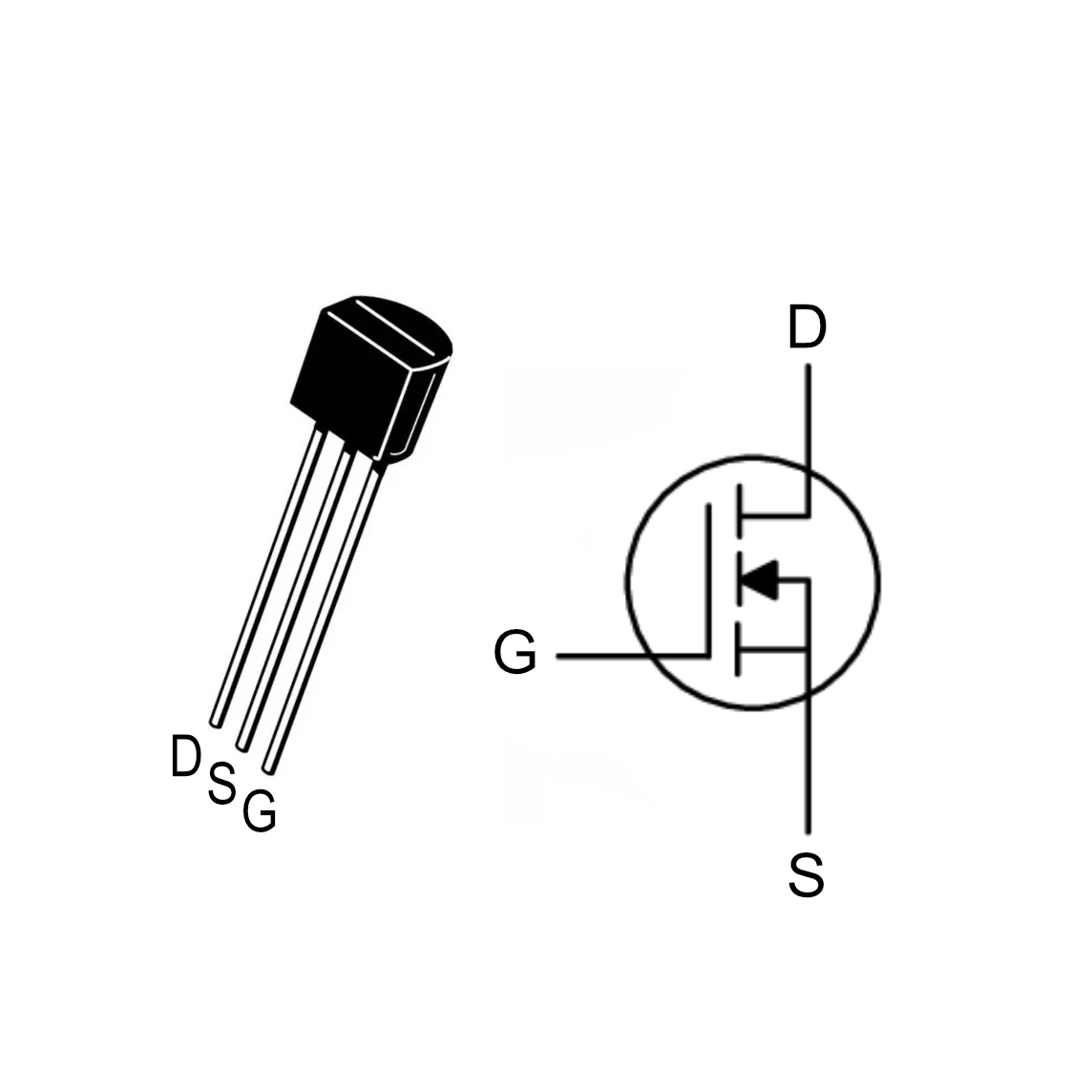
Here's an interesting truth about MOSFETs: they weren't designed for audio at all. The MOSFET was engineered to be a near-perfect high-speed switch. The insulated gate allows MOSFETs to flip between "on" and "off" billions of times per second with almost no energy loss. This is why every modern CPU, microcontroller, and digital chip is built from billions of tiny MOSFETs working as switches.
So what's a digital switch doing in a guitar pedal? It turns out the same properties that make MOSFETs excellent switches (the ultra-high input impedance, the fast response, the voltage-controlled nature) also make them useful for audio amplification. They're just a rare choice. Most pedal designers reach for BJTs, JFETs, or op-amps first. But when a circuit does use a MOSFET for gain, it brings some unique characteristics to the table.
MOSFET Characteristics
5. Op-Amps (The Integrated Circuit)
The final pillar packs many components into one tiny chip. The Operational Amplifier, or Op-Amp, is an Integrated Circuit (IC) that houses dozens of transistors, resistors, and capacitors inside a single silicon chip. Originally designed for analog computers to perform mathematical functions, pedal designers discovered that these chips could provide massive, stable gain with nearly perfect transparency.

The op-amp's greatest strength is its reliability. Unlike discrete transistors that vary wildly from unit to unit, IC op-amps are manufactured to tight specifications. Every JRC4558 behaves like every other JRC4558. This repeatability, combined with extremely low noise and high gain, made op-amps the backbone of the most iconic overdrive pedals ever created. The Ibanez Tube Screamer, the Klon Centaur, the Marshall Bluesbreaker, the Boss SD-1, the ProCo Rat, the MXR Distortion+: all op-amp circuits. When you hear "the sound of overdrive," you're almost certainly hearing an op-amp at work.
But here's the catch: op-amps weren't designed to clip gracefully. When a tube or JFET runs out of headroom, it rounds off the peaks of your waveform in a musically pleasing way. When an op-amp runs out of headroom, it clips abruptly at the power rails, producing harmonics that can sound harsh without additional shaping. So how do all those legendary pedals sound so good? The secret is clipping diodes: silicon or germanium diodes placed in the circuit to shape the distortion character. Silicon diodes create a harder, more aggressive clip. Germanium diodes produce a softer, warmer saturation. Pedals like the Tube Screamer use "soft clipping" (diodes in the feedback loop, which dynamically reduces gain as the signal increases). Others, like the ProCo Rat, use "hard clipping" (diodes to ground after the gain stage). The Rat's distinctive voice also comes from its LM308 op-amp's slow slew rate, which rolls off highs as you push it harder.
Op-Amp Characteristics
Biasing: Finding the Center
For any of these pillars to work, they must be "biased." In our dam analogy, this is the act of setting your paddle at the correct height before the stream even hits it. If the paddle is sitting too low and resting on the ground, the weak stream must exert significant force just to lift it. This results in a "choked" or "gated" sound where the subtle details of your playing are lost.
If the paddle is sitting too high, it barely skims the surface and fails to react to the valleys of the oscillating signal. Proper biasing ensures the paddle is perfectly submerged. This allows it to move effortlessly in both directions, ensuring the large flow from the reservoir perfectly mirrors every ripple of your guitar signal.
The Art of Biasing
In practice, biasing is achieved by applying a small DC voltage to the control terminal (Grid, Base, or Gate) to set the operating point. Many vintage fuzz circuits have external bias trimpots or controls, allowing players to "starve" the bias for a gated, sputtery sound, or set it perfectly for maximum clarity and sustain. The famous "voltage sag" of dying batteries in old Fuzz Faces is actually a form of improper biasing that some guitarists have come to love.
Summary Table: The Physics of Control
| Pillar | Control Method | Input Impedance | Iconic Examples |
|---|---|---|---|
| Vacuum Tube | Voltage | High | Fender Twin, Vox AC30 |
| BJT (Ger/Si) | Current | Low/Medium | Fuzz Face, Tone Bender |
| JFET | Voltage | High | EP-3 Preamp, Boss FA-1 |
| MOSFET | Voltage | Very High | Z.Vex SHO, Fulltone OCD |
| Op-Amp (IC) | Voltage | High | Tube Screamer, Klon, Rat |
The Art of the Gain Stage
Whether it is the "leaky" charm of a germanium transistor or the high-speed precision of a MOSFET, the choice of an amplification pillar is the most important decision a designer makes. It dictates how the pedal feels, how it responds to your touch, and how it interacts with the rest of your signal chain. Understanding these five pillars allows you to see the electrical reality behind the legendary tones of the last seventy years.

The PION: Three Pillars in One Pedal
When I designed the PION, I started with a simple question: what if you could have three of these pillars in a single enclosure? Tubes were off the table for practical reasons. MOSFETs, while capable, felt too harsh for my taste. That left BJT, JFET, and Op-Amp: the three most sonically distinct approaches to solid-state gain. The result is a pedal that lets you access any combination of these three pillars, in one box.